
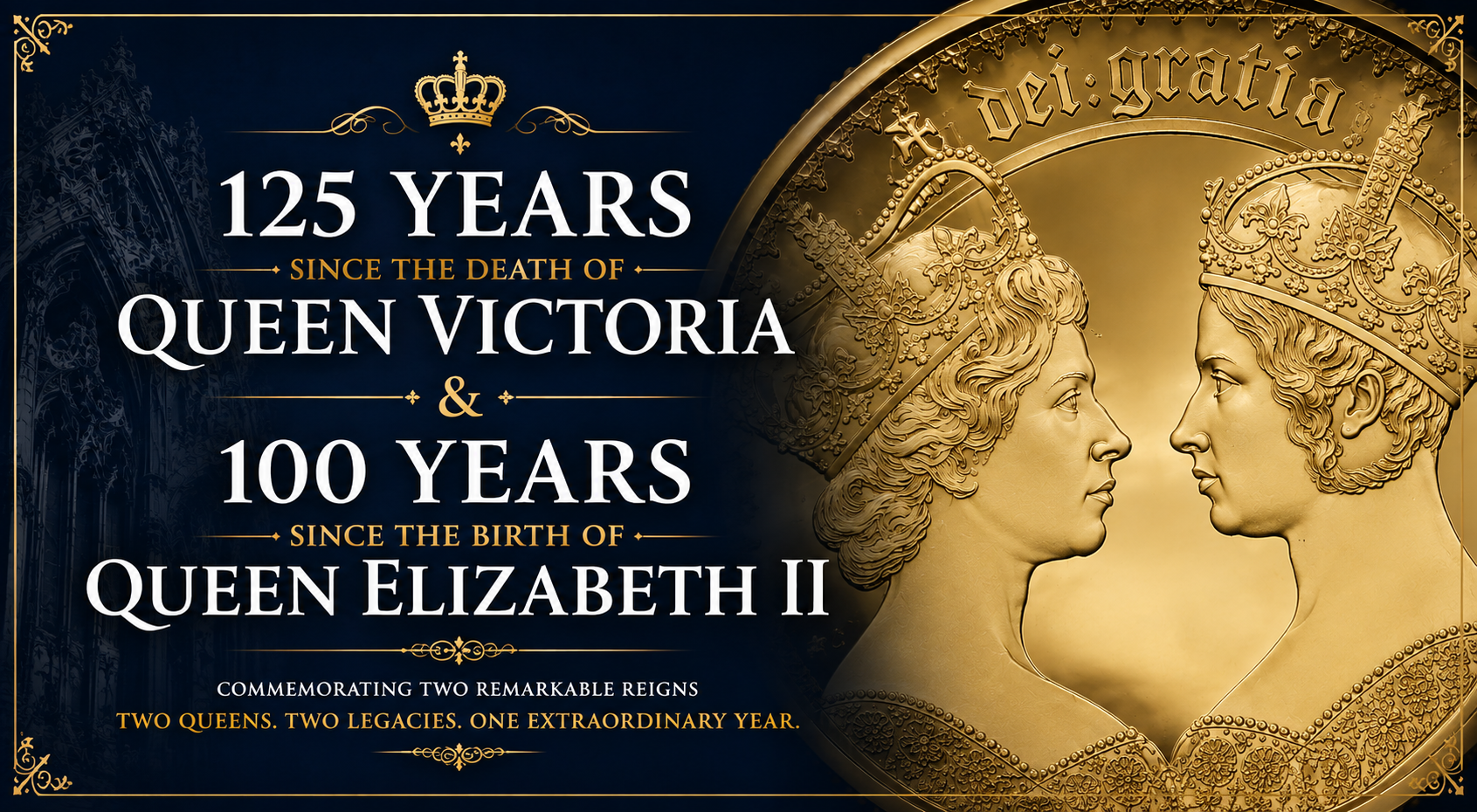
125 Years Since the Death of Queen Victoria and 100 Years Since the Birth of Queen Elizabeth II
The year 2026 marked two extraordinary milestones in British royal history. On 22 January, the nation commemorated the 125th anniversary of the death of Queen Victoria, while on 21 April, it marked the 100th anniversary of the birth of Queen Elizabeth II.
Although separated by more than a century, these two remarkable women share an unparalleled place in Britain’s story. Together, they reigned for more than 133 years, making them Britain’s two longest-reigning monarchs. Each came to the throne as a young woman, each guided the nation through periods of profound change, and each became a symbol of stability, continuity and public service.
These twin anniversaries provided an opportunity to reflect on two reigns that helped shape the modern monarchy and left an enduring legacy that continues to inspire historians, royal enthusiasts and collectors alike.
Queen Victoria: The Monarch Who Defined an Age
Queen Victoria became Queen on 20 June 1837, following the death of King William IV. She was just 18 years old.
Her reign lasted 63 years and 216 days, making her the longest-reigning British monarch until Queen Elizabeth II surpassed her record in September 2015.
During Victoria’s reign, Britain underwent extraordinary transformation. Railways expanded across the country, manufacturing flourished, scientific innovation accelerated and the electric telegraph revolutionised communication. Britain also emerged as one of the world’s leading industrial and imperial powers, and the period became so closely associated with the Queen that it remains known today as the Victorian era.
Victoria married Prince Albert of Saxe-Coburg and Gotha in 1840. Together they had nine children, many of whom married into Europe’s royal families, earning Victoria the nickname “The Grandmother of Europe.”
Prince Albert played a leading role in organising the Great Exhibition of 1851, celebrating Britain’s achievements in industry, engineering and design. Following Albert’s death in 1861, Victoria entered a prolonged period of mourning and wore black for the remainder of her reign.
The Royal Titles Act was passed in 1876, and Victoria formally became Empress of India in 1877. Her Golden Jubilee in 1887 and Diamond Jubilee in 1897 celebrated not only the longevity of her reign but also the esteem in which she was held across Britain and the Empire.
Queen Elizabeth II: A Century Since Her Birth
More than a century after Queen Victoria’s birth, Princess Elizabeth Alexandra Mary was born on 21 April 1926.
Few could have imagined that the young princess would become Britain’s longest-reigning monarch. Following the death of her father, King George VI, she acceded to the throne on 6 February 1952 at the age of 25.
Over the next 70 years and 214 days, Queen Elizabeth II became a reassuring constant through decades of unprecedented change. Her reign witnessed widespread decolonisation, the transformation of the British Empire, the development of the modern Commonwealth, the space age, the digital revolution and enormous social and technological progress.
Throughout it all, she remained devoted to public service, earning admiration both in Britain and around the world. By the time of her death on 8 September 2022, Queen Elizabeth II had become one of the most respected and recognisable figures of the modern age.
Two Remarkable Reigns
Although they lived in different centuries, Queen Victoria and Queen Elizabeth II shared many striking similarities.
Both became Queen as young women and dedicated their lives to public service. Both experienced the loss of a beloved husband while on the throne, yet continued to carry out their constitutional duties with remarkable determination. Both presided over periods of immense political, technological and social change, becoming enduring symbols of continuity when the world around them was changing rapidly.
Taken together, their reigns reached across an extraordinary period of British history, from Queen Victoria’s accession in 1837 to Queen Elizabeth II’s death in 2022. Their combined legacy continues to define the modern monarchy.
Two Queens on Britain’s Coinage
Both monarchs are among the most celebrated figures ever to appear on British coinage.
Queen Victoria appeared on three principal coinage portraits during her reign: William Wyon’s Young Head, Sir Joseph Edgar Boehm’s Jubilee Head, and Sir Thomas Brock’s Old Head, also known as the Veiled Head. These portraits remain among the most admired designs in British numismatic history.
Queen Elizabeth II appeared on five definitive coinage portraits during her reign, reflecting the different stages of her remarkable life. Her fifth and final portrait, created by renowned coin artist Jody Clark, became one of the most recognisable images of the late Queen.
Together, their portraits chart more than 180 years of British royal history and continue to captivate collectors around the world.
Commemorating Two Historic Royal Anniversaries
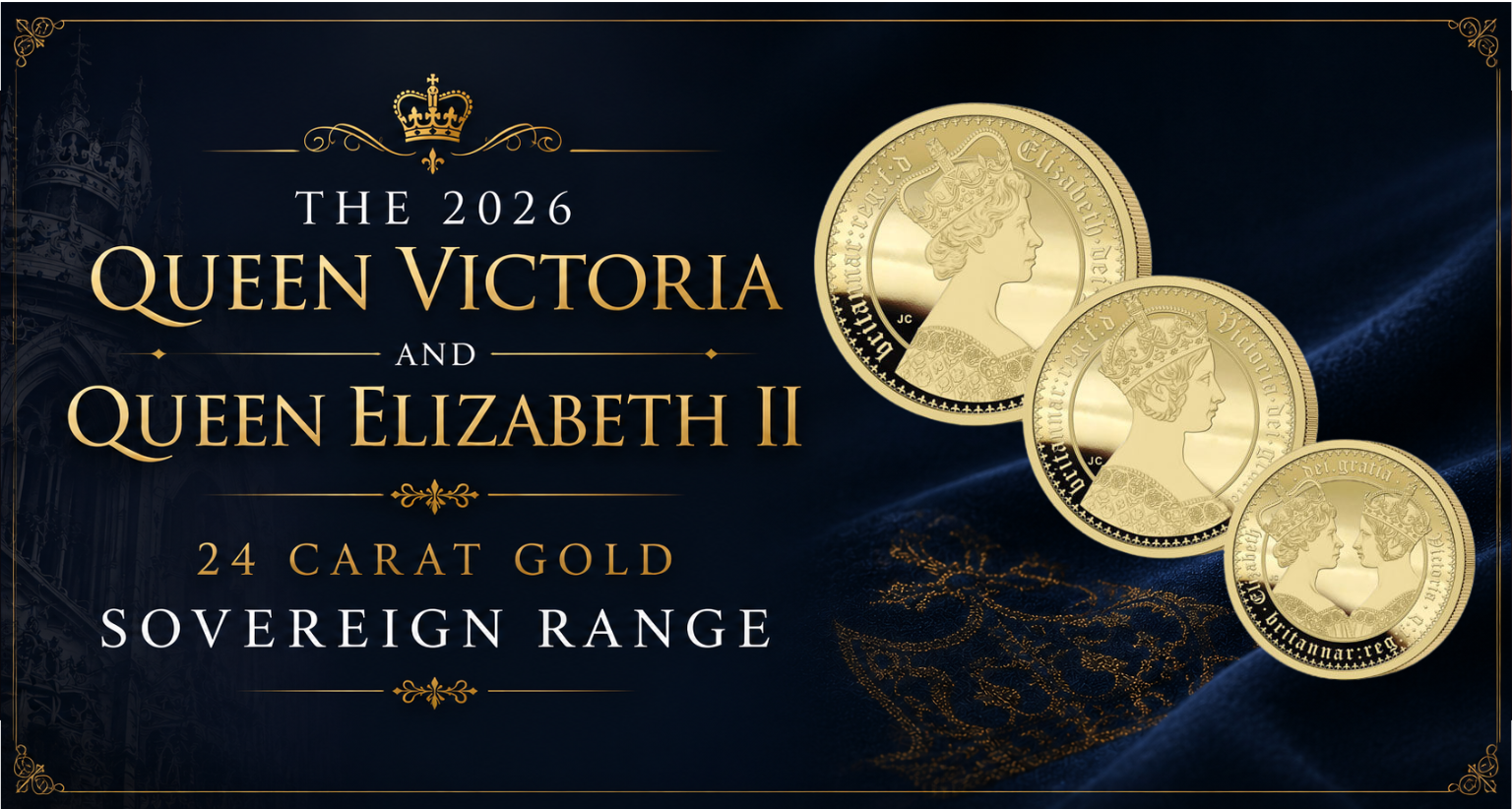 The convergence of these two landmark anniversaries inspired a remarkable new series of 24 carat gold sovereign coins.
Designed by renowned coin artist Jody Clark, the collection brings Queen Victoria and Queen Elizabeth II together in historic Gothic style for the first time ever on a sovereign, making it a genuine world first. Inspired by the celebrated Gothic Crown of 1847 and the Gothic Florin, the design combines elegant royal portraiture with richly decorative Gothic lettering, paying tribute to one of the most admired artistic traditions in British coinage.
Struck in 99.99% pure 24 carat gold, an unusual purity for sovereign coins, which are traditionally produced in 22 carat gold, the collection celebrates two monarchs whose combined reigns helped shape modern Britain and whose influence continues to inspire generations.
A Legacy That Endures
The anniversaries commemorated in 2026 served as a reminder of the extraordinary contributions made by Queen Victoria and Queen Elizabeth II to Britain’s history.
Separated by more than a century yet united by an unwavering sense of duty, both queens guided the nation through periods of profound change while preserving the continuity of the Crown. Their reigns helped shape the monarchy as we know it today and left an enduring legacy that continues to resonate across Britain and the wider world.
For collectors, historians and royal enthusiasts alike, the lives of Queen Victoria and Queen Elizabeth II remain a source of enduring fascination. Their remarkable achievements, now commemorated through two historic anniversaries and a world-first sovereign collection, ensure that Britain’s two longest-reigning monarchs will continue to be remembered for generations to come.

